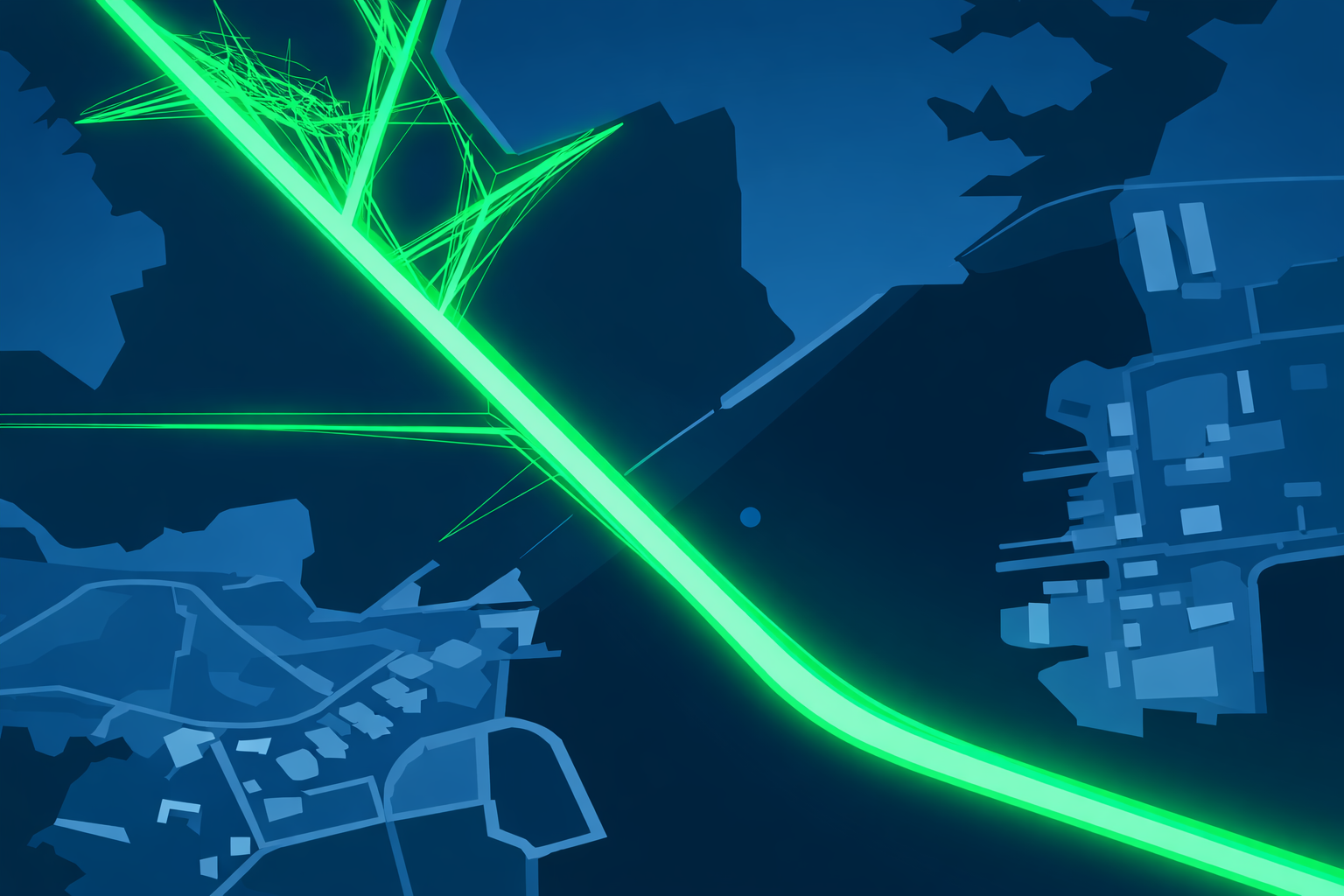
The ship track everyone sees
Thousands of uneventful transits may demonstrate professional competence and operational reliability. They do not necessarily demonstrate that catastrophic exposure has been identified or adequately governed.
HarborArc helps ports, infrastructure owners, insurers and maritime leaders examine how foreseeable operational failure can interact with physical and operational systems to produce unacceptable outcomes — before an accident reveals the exposure.
The same operational failure can have radically different consequences depending on where it occurs. A blackout in open water may result in delay and towage assistance; beneath a major bridge, alongside a fuel terminal or within a constrained approach channel, the same failure may open a pathway to catastrophic consequence.
Competence, procedures, engineering reliability and compliance reduce the occurrence of failure, but no credible governance framework can assume operational failure will be eliminated altogether.
Physical configuration, operational context and the presence of consequence multipliers shape what a foreseeable operational failure is capable of becoming.
The objective is to make unacceptable outcomes, consequence multipliers and the conditions governing escalation explicit enough for leadership to decide whether the exposure is legitimate, recoverable and survivable.
The HarborArc framework begins by defining which outcomes are unacceptable. It then identifies the consequence multipliers capable of producing those outcomes and examines catastrophic exposure through three complementary governance functions: exposure legitimacy, recoverability and survivability.
Define the losses the system must ultimately protect against: loss of life, critical infrastructure failure, environmental harm, economic disruption or other outcomes judged unacceptable by the responsible organisation.
Identify the physical features whose interaction with a vessel could transform a foreseeable operational failure into one or more defined unacceptable losses — for example bridges, fuel terminals, LNG facilities, environmentally sensitive areas, coastlines or confined waterways.
Ask whether the operational practice creating the catastrophic exposure is appropriate in its present form, or whether the exposure should be reduced, constrained, redesigned or consciously accepted.
If operational failure occurs, examine whether control can be regained before irreversible interaction with the identified consequence multiplier occurs.
If interaction with the consequence multiplier becomes unavoidable, examine whether structural resilience, protective systems, emergency response and other safeguards are sufficient to prevent the defined unacceptable outcomes.
Thousands of uneventful transits may demonstrate professional competence and operational reliability. They do not necessarily demonstrate that catastrophic exposure has been identified or adequately governed.
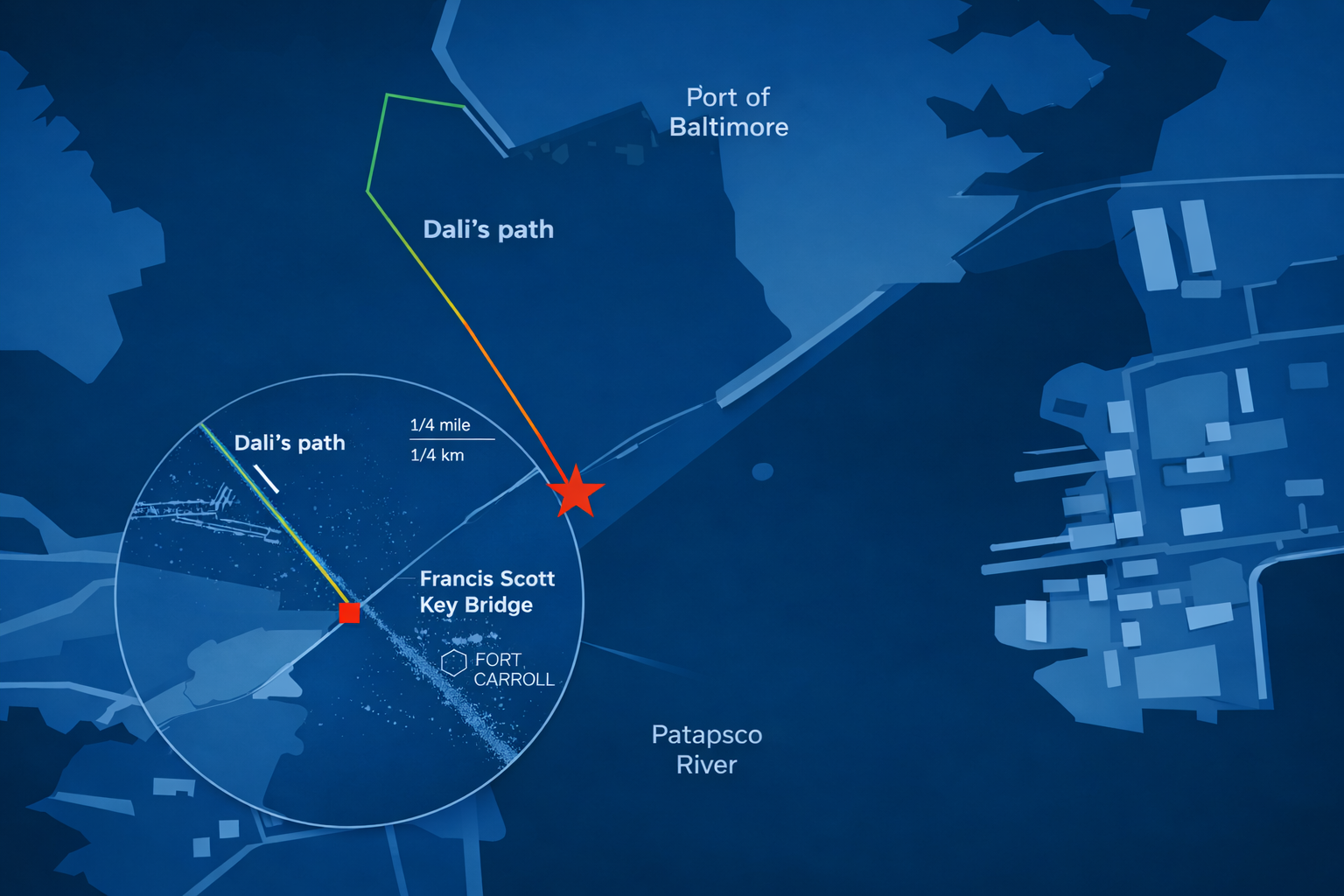
A catastrophic-exposure view asks what physical and operational conditions are already present, which consequence multiplier could be involved, and whether recovery or survivability remains if prevention is unsuccessful.
HarborArc does not replace navigation simulation, engineering analysis, formal risk assessment, regulation or professional judgement. It provides a consequence-first governance lens intended to identify where those disciplines may need to be directed, integrated or challenged by the potential for unacceptable loss.
A bounded application of the HarborArc catastrophic-exposure framework to one port system, asset or vessel–infrastructure interaction.
Best for: organisations that want to test whether a consequence-first review reveals material exposure, governance questions or evidence gaps not already made sufficiently visible by existing processes.
Discuss a pilot assessmentA focused leadership session examining catastrophic exposure as a distinct governance problem that complements the prevention of operational failure.
Best for: boards, executive teams, insurers, port authorities and infrastructure owners.
Request a briefingHow repeated successful operation and professional competence can coexist with catastrophic exposure that remains unrevealed.
Purpose: create a sharper shared language for the exposure that ordinary safety metrics may not show.
Enquire about speakingThe central HarborArc proposition has been published in Seaways: catastrophic exposure may exist independently of the failure that eventually reveals it and, if so, can be identified, characterised and governed before an accident occurs. HarborArc does not present this as a replacement for established risk, resilience or engineering disciplines; the assessment approach must earn its value through application.
“A new approach to identifying and managing consequence multipliers.” The article sets out the case for treating catastrophic exposure as a distinct object of governance alongside — not instead of — the prevention of operational failure.
The conference presentation examined how competence, familiarity and successful history can coexist with exposure embedded in the geometry of a system.
The next stage is structured application against live port systems: test whether the framework identifies material exposure or governance questions beyond existing processes, challenge its assumptions, and refine the assessment method from evidence.
Begin with the losses the system must protect against rather than beginning only with a list of initiating hazards.
Identify the physical features whose interaction with a vessel could transform a foreseeable operational failure into the defined unacceptable outcomes.
Ask whether the operational practice creating the exposure is appropriate given the magnitude and nature of the consequences at stake.
Examine whether there is sufficient time, sea room, vessel capability and operational support to prevent irreversible interaction with the consequence multiplier.
Examine whether structural resilience, protective systems, emergency response and other safeguards are sufficient to interrupt escalation.
Direct simulation, engineering, operational review, capital protection or formal acceptance to the governance level appropriate to the exposure identified.

HarborArc was founded by Andrew Baker AFNI, a marine pilot and maritime professional working at the interface between ship handling, port systems and catastrophic consequence. He holds a bachelor’s degree in Civil Engineering and a Master Mariner Unlimited certificate.
Andrew's work focuses on a narrow question: why can a foreseeable operational failure that is manageable in one location become catastrophic in another? HarborArc develops that question through the identification of unacceptable outcomes and consequence multipliers, followed by examination of exposure legitimacy, recoverability and survivability.
The objective is not to compete with existing safety systems or technical disciplines. It is to provide a consequence-first governance framework that helps ports, insurers, infrastructure owners and regulators see where deeper technical evidence, operational change or governance attention may be justified.
The strongest starting point is not a broad consultancy brief. It is one consequential port system, asset or vessel–infrastructure interaction where you want to know whether existing processes are making catastrophic exposure sufficiently visible.